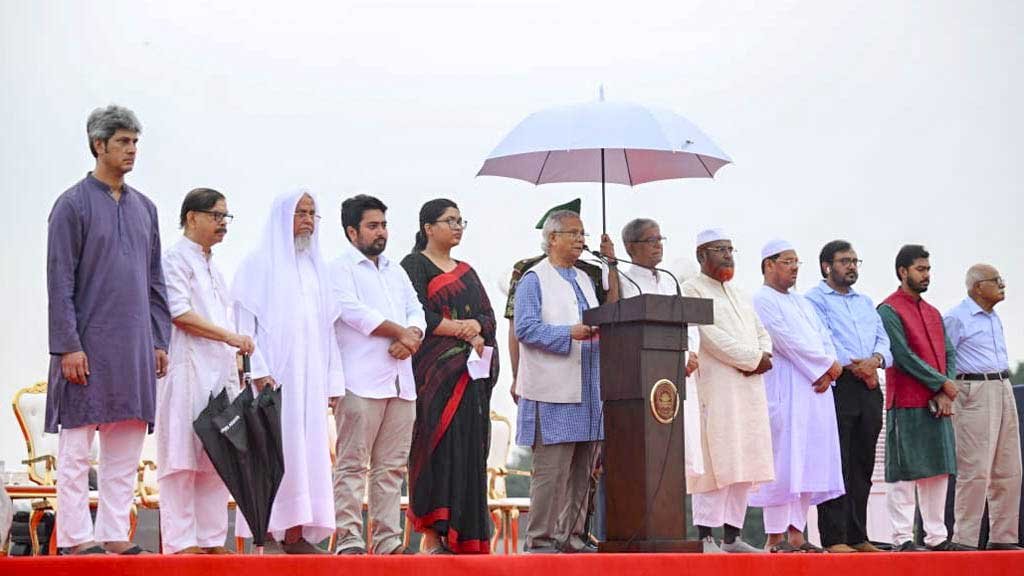
Managing disputes over the election results will be the most severe challenge for interim government chief Muhammad Yunus, International Crisis Group has said.
In a question-and-answer session published on the Crisis Group website, its analyst Thomas Kean said Yunus’s administration has so far survived by maintaining consensus among the military and major political parties, but that balance could be thrown off once results are declared.
The assessment comes amid heightened international attention on Bangladesh’s polls, being held just two years after the last general election that returned Sheikh Hasina’s Awami League to power in a landslide.
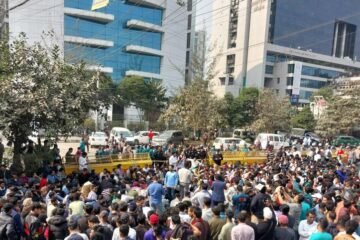
The risk, Kean said, is heightened by weakened law enforcement capacity, rising incidents of “mob” violence, and increasing competition among political forces seeking to fill the vacuum left after the ouster of the Awami League in a mass uprising.
Since Hasina’s removal, established parties and newer groups such as the National Citizen Party (NCP) have moved quickly to consolidate political ground.
Kean noted that the competition to fill that space has already triggered violence in several areas, citing incidents linked to election campaigning as well as the killing of Sharif Osman bin Haadi, a leader of Inqilab Moncho and prospective candidate from Dhaka.
He warned of a continued risk of attacks on candidates and voters, alongside possible reprisals against Awami League supporters and members of the Hindu minority, who are often perceived as loyal to Hasina’s party.
According to Kean, Yunus made compromises across the political spectrum to secure agreement on reforms and pave the way for the Feb 12 election.
Managing any post-election dispute, however, would be the interim government’s most “severe test” and could escalate into a broader political crisis, he said.
He identified the Jamaat-e-Islami as one of the parties likely to dispute the outcome, but added that it views the vote as a foundation for future political gains.
“Jamaat insiders say they do not expect to win and instead view the poll as a stepping stone to the next elections in five years’ time,” Kean said.
He argued that despite the risks, the vote could restore constitutional normalcy and produce a government with a genuine popular mandate for the first time since 2008, when the Awami League was voted into power.
He outlined significant challenges awaiting the next administration, including weak state institutions, a slowing economy heavily dependent on garment exports and remittances, and mounting climate pressures in one of the world’s most densely populated countries.
Foreign policy will also pose difficulties, he said, particularly managing ties with India, navigating the intensifying rivalry between the United States and China, and addressing the prolonged Rohingya refugee crisis along the Bangladesh-Myanmar border.
Kean also flagged concerns over the “growing visibility” of radical Islamist groups since Hasina’s removal and questioned the capacity of security agencies to monitor extremist activity effectively.
He identified unmet youth expectations as the most serious long-term threat to stability.
With roughly half of Bangladesh’s population under 30, many young people face unemployment or underemployment and demand greater integrity in governance and fairer distribution of economic growth.
Failure to deliver reforms, starting with commitments under the July Charter, could deepen public disillusionment, Kean warned.